Showing posts with label Software Development Methodology. Show all posts

Sunday, August 15, 2010

Agile Case Study - Software marketing

Software Marketing, enter a world of countless project requests, numerous stakeholders, limited resources and rapidly changing market conditions.

Sound familar? In fact, marketers face a lot of the same challenges as development teams, and Agile can be a powerful way to alleviate those common issues and intelligently plan our work.

10 Steps to successful Marketing using Agile and Lean Practices:

In steps 1-5, Explain how marketing team conducts our version of release planning.
In step 6-10, Explain how we run our iterations to meet those commitments. Our planning processes continue to evolve, through this method has worked for a while now.


PART 1
STEP 1: We recognize that Marketing has challenges that are different from development.
  • There is no unique product owner: for example if we chose Sales, when we would always rank lead generation over branding, customer programs or analyst relations, and that could ultimately hurt our company. Therefore we have to use some best-guessing to prioritize our backlog and determine what is most important.
  • We face hard event deadlines set far into the future. Sometimes we have no choice but to commit to an event or sign a contract months ahead of time.
  • Each team member has unique expertise, i.e. writing, event planning, PHP development and so forth. So one shared backlog is inefficient.
Now that we've reviewed the challenges,w e give ourselves permission to do what we need to do, have patience and adjust anything that isn't working for us.

STEP 2: Conduct an ORID to learn from the past:
Before planning for the next quarter, we hold a retrospective in the form of an ORID, “a means to analyze facts and feelings, to ask about implications and to make decisions intelligently”, a process created by the Institute of Cultural Affairs. We gather as a team to share

  • Observations (O) – What do we know?
  • Reflections (R) – How do we feel about this?
  • Interpretations (I) – What does it mean for the organization?
  • Decisions (D) – What are we going to do?
This strategic overview helps set context for us to prioritize our focus for next quarter.

STEP 3: Align ORID decision with company strategy:
We conduct quarterly (as per company strategy) and annual planning using the Plan Do Check Adjust methodology as explained in Getting the Right Things Done.  As we look at the overall company direction and goals, we keep these in mind as we hold planning at our own level.   Ideally, our major commitments support and align with company strategy. This also helps inform our “stop doing” list.

STEP 4: Poll our stack holders:
As part of determining quarterly commitments, we poll our major stakeholders for their top requests.  We use a Google survey to rank these requests by importance, size each request and bring these epics into our release planning meeting, to be included as part of our ranked backlog.

STEP 5: Conduct release planning to prioritize and agree on quarterly commitment:
Now that we have all of our inputs, we hold our quarterly Release Planning session.  We write each epic on a sticky note and look at all of the possible work we could do this quarter.  Then, we evaluate epics based on importance taking company goals, stakeholder wishes, market realities like conferences and our own passions into consideration. We decide what we can realistically commit to, and agree as a team.  We keep in mind that making and meeting commitments is a huge deal, and we try really hard not to over-commit.
PART 2
STEP 6: Create a task board:
Since our marketing team is mostly co-located, we pin up several large sheets of paper to use as a task board.  This is where we review our commitments on a daily basis as a sanity check that our stories are prioritized correctly and that we are tackling the right work as the quarter progresses.

As a team, we write our quarterly commitments on the task board with the definition of done assigned to each one.  We also include our “foundational” work – recurring work like website updates, online ad campaigns, field events, press releases and other important work that we need time to do.
We break into smaller project teams that do share a backlog, we often use AgileZen to manage this work.

STEP 7: Hold Iteration planning every two week:
Every 2 weeks, we hold an Iteration Planning meeting.  Each team member has her own sticky note color, creates stories on those notes and manages her own prioritized backlog using T-shirt sizing to roughly estimate each story.  In this hour-long meeting, we begin by expressing appreciation for team members who gave exceptional assistance.  Then we hold a brief retrospective on what worked and what should change for the next iteration.  Finally, we each read out our prioritized stories for the iteration, putting them on the task board’s backlog.  This gives everyone visibility to what’s happening, identifies if someone is over-committed and lets the team swarm any epics with looming deadlines

STEP 8: Conduct a daily Stand up meeting:
At the same time each day, we hold a stand-up meeting (with a consistent conference call #) that is at most 10-15 minutes long.  We form a semi-circle in front of our task board and share no more than 2 cross-cutting significant actions or take-aways from the day before, no more than 2 that we are planning to accomplish that day, and whether our work is blocked by any issues beyond our control.   As we start working on stories throughout the iteration, we move them from the backlog into their section of the task board to show what we are working on.  When the story is complete, then we move it to a place on the task board labeled “Done”.  Once the commitment’s Definition of Done is met, we check off that commitment and feel good about completing it.

STEP 9: Be patience as things change:
It would be lovely if nothing changed during the iteration, but that just doesn’t happen.  The goal is ultimately to respond to change rather than cling to an outdated plan.  As new opportunities arise, new time-sensitive information appears and new requests are made, so our iteration work changes and that’s ok.  We try to just document what we’re working on and create new stories so that we can make intelligent prioritization decisions during the course of the iteration.

STEP 10: Retrospect, Inspect and Adapt:
As we keep running our iterations and fulfilling our commitments, we are always looking for ways to improve them.   Ultimately, we’re using Agile to improve the quality of our work life by using objective, smart ways of planning how we spend our time. And we’re learning a lot from the journey.

Monday, August 2, 2010

Software Development Methodology

"A Software Development Methodology is the concept / best practices or guidelines for managers to streamline the process, instructing them how to plan, control, estimate, involving team members and quickly delivers quality software by minimizing risks, cost and failures."

A software / system development methodology in software engineering has various meanings to various audiences.
  • As a noun, a software development methodology is a framework that is used to structure, plan, and control the process of developing an information system.
    • Rational Unified Process: - since 1998
    • Agile Unified Process: since 2005
    • Integrated Unified Process: since 2007
  • As a verb, the software development methodology is an approach to be used by an organization or project team to apply the software development methodology framework
    • Waterfall Approach (linear): Waterfall approach is a sequential development approach, in which development is seen as flowing steadily downwards (like a waterfall) through the phases of requirement analysis, design, implementation, testing (validation), integration and maintenance.
    • Protyping Approach (iterative): Software prototyping is the development approach of activities during software development the creating of prototypes, i.e. incomplete versions of the software program being developed.
    • Incremental Approach (combination of linear and iterative): Various methods are acceptable for combining linear and iterative systems development methodology approaches, with the primary objective of each being to reduce inherent project risk by breaking a project into smaller segments and providing more ease-of-change during the development process.
    • Spiral Approach (combination of linear and iterative): The spiral model approach is a software development process combining elements of both design and prototyping-in-stages, in an effort to combine advantages of top-down and bottom-up concepts.
    • Rapid Application Development (RAD) Approach (Iterative): Rapid Application Development (RAD) is a software development methodology approach, which involves iterative development and the construction of prototypes.
    • Extreme Programming Approach:
  • Waterfall Approach: Basic Principle of Waterfall approach is:
    • Project is divided into sequential phases, with some overlap and spash back acceptable between phases.
    • Emphasis is on planning, time schedules, target dates, budgets and implementation of an entire system at one time.
    • Tight control is maintained over the life of the project through the use of extensive written documentation, as well as through formal reviews and approval/signoff by the user and information technology management occurring at the end of most phases before beginning the next phase.
  • Protyping Approach: Basic principles of the Prototyping Approach are:
    • Not a standalone, complete development methodology approach, but rather an approach to handling selected portions of a larger, more traditional development methodology (i.e. incremental, Spiral or Rapid Application Development (RAD)) approaches.
    • Attempts to reduce inherent project risk by breaking a project into smaller segments and providing more ease-of-change during the development process.
    • User is involved throughout the development process, which increases the likelihood of user acceptance of the final implementation.
    • Small-scale mock-ups of the system are developed following an iterative modification process until the prototype evolves to meet the user’s requirements.
    • While most prototypes are developed with the expectation that they will be discarded, it is possible in some cases to evolve from prototype to working system.
    • A basic understanding of the fundamental business problem is necessary to avoid solving the wrong problem.
    • Mainframes have a lot to do with this sort of thing.
  • Incremental Apprach: Basic principles of the incremental development approach are:
    • A series of mini-Waterfalls are performed, where all phases of the Waterfall development approach are completed for a small part of the systems, before proceeding to the next incremental, or
    • Overall requirements are defined before proceeding to evolutionary, mini-Waterfall development approaches of individual increments of the system, or
    • The initial software concept, requirements analysis, and design of architecture and system core are defined using the Waterfall approach, followed by iterative Prototyping approach, which culminates in installation of the final prototype (i.e., working system).
  • Spiral Approach - basic principles.
    • Focus is on risk assessment and on minimizing project risk by breaking a project into smaller segments and providing more ease-of-change during the development process, as well as providing the opportunity to evaluate risks and weigh consideration of project continuation throughout the life cycle.
    • Each cycle involves a progression through the same sequence of steps, for each portion of the product and for each of its levels of elaboration, from an overall concept-of-operation document down to the coding of each individual program.
    • Each trip around the spiral approach traverses four basic quadrants: 
      • determine objectives, 
      • alternatives, and constraints of the iteration; 
      • Evaluate alternatives; Identify and resolve risks; 
      • develop and verify deliverables from the iteration; 
      • Plan the next iteration.
    • Begin each cycle with an identification of stakeholders and their win conditions, and end each cycle with review and commitment.
  • Rapid Application Development (RAD) Approach – Basic Principles.
    • Key objective is for fast development and delivery of a high quality system at a relatively low investment cost.
    • Attempts to reduce inherent project risk by breaking a project into smaller segments and providing more ease-of-change during the development process.
    • Aims to produce high quality systems quickly, primarily through the use of iterative Prototyping (at any stage of development), active user involvement, and computerized development tools. These tools may include Graphical User Interface (GUI) builders, Computer Aided Software Engineering (CASE) tools, Database Management Systems (DBMS), fourth-generation programming languages, code generators, and object-oriented techniques.
    • Key emphasis is on fulfilling the business need, while technological or engineering excellence is of lesser importance.
    • Project control involves prioritizing development and defining delivery deadlines or “timeboxes”. If the project starts to slip, emphasis is on reducing requirements to fit the timebox, not in increasing the deadline.
    • Generally includes Joint Application Development (JAD), where users are intensely involved in system design, either through consensus building in structured workshops, or through electronically facilitated interaction.
    • Active user involvement is imperative.
    • Iteratively produces production software, as opposed to a throwaway prototype.
    • Produces documentation necessary to facilitate future development and maintenance.
    • Standard systems analysis and design techniques can be fitted into this framework.
  • Agile Unified Process (AUP): Agile describes a simple, easy to understand approach to developing business application software using agile techniques and concepts yet still remaining true to the RUP. The AUP applies agile techniques including test driven development (TDD), Agile Modelling, agile change management and database refactoring to improve productivity.
Agile SCRUM

    • Unlike RUP, the AUP has only seven disciplines.
      • Model. Understand the business of the organization, the problem domain being addressed by the project, and identify a viable solution to address the problem domain.
      • Implementation. Transform model(s) into executable code and perform a basic level of testing, in particular unit testing.
      • Test. Perform an objective evaluation to ensure quality. This includes finding defects, validating that the system works as designed, and verifying that the requirements are met.
        Deployment. Plan for the delivery of the system and to execute the plan to make the system available to end users.
      • Configuration Management. Manage access to project artifacts. This includes not only tracking artifact versions over time but also controlling and managing changes to them.
      • Project Management. Direct the activities that takes place within the project. This includes managing risks, directing people (assigning tasks, tracking progress, etc.), and coordinating with people and systems outside the scope of the project to be sure that it is delivered on time and within budget.
      • Environment. Support the rest of the effort by ensuring that the proper process, guidance (standards and guidelines), and tools (hardware, software, etc.) are available for the team as needed.
    • Agile Philosphies: The Agile UP is based on the following philosophies:
      • Your staff knows what they're doing. People are not going to read detailed process documentation, but they will want some high-level guidance and/or training from time to time. The AUP product provides links to many of the details, if you are interested, but doesn't force them upon you.Simplicity. Everything is described concisely using a handful of pages, not thousands of them.
      • Agility. The Agile UP conforms to the values and principles of the agile software development and the Agile Alliance.
      • Focus on high-value activities. The focus is on the activities which actually count, not every possible thing that could happen to you on a project.
      • Tool independence. You can use any toolset that you want with the Agile UP. The recommendation is that you use the tools which are best suited for the job, which are often simple tools.
      • You'll want to tailor the AUP to meet your own needs.
Agile Software Development LifeCycle

    • Releases: The Agile Unified Process distinguishes between two types of iterations. A Development Release Iteration results in a deployment to the Quality Assurance and/or Demo area. A Production Release Iteration results in a deployment to the Production area. This is a significant refinement to the Rational Unified Process.

Wednesday, July 28, 2010

The Agile System Development Life Cycle (SDLC)

The Agile System Development Life Cycle (SDLC)
I'm often asked to over viewing the ideas presented in the  Agile Manifesto and agile techniques such as  Test-Driven Design (TDD),  database re factoring, and  agile change management. One issue that many people seem to struggle with is how all of these ideas fit together, and invariably I found myself sketching one or more pictures which overview the life cycle for agile software development projects.  I typically need one or more pictures because the scope of life cycles change -- some life cycles address just the construction life cycle, some address the full development life cycle, and some even address the full IT life cycle.  Depending on your scope, and how disciplined your approach to agile software development is, you will get different life cycle diagrams.

This article covers:
# 1: The scope of life cycles
# 2: Iteration -1: Pre-project planning
# 3: Iteration 0: Project inception
# 4: Construction iterations
# 5: Release iterations
# 6: Production
# 7: Retirement


1. The Scope of Life Cycles:
In Enterprise Unified Process (EUP) the scope of life cycles can vary dramatically.  For example, Figure 1 depicts the Scrum construction life cycle whereas Figure 2 depicts an extended version of that diagram which covers the full system development life cycle (SDLC) and Figure 3 extends that further by addressing enterprise-level disciplines via the EUP life cycle.  The points that I'm trying to make are:
  • System development is complicated: Although it's comforting to think that development is as simple as Figure 1 makes it out to be, the fact is that we know that it's not.  If you adopt a development process that doesn't actually address the full development cycle then you've adopted little more than consultant ware in the end.  My experience is that you need to go beyond the construction life cycle of Figure 1 to the full SDLC of Figure 2 (ok, Retirement may not be all that critical) if you're to be successful

  • There's more to IT than development: To be successful at IT you must take a multi-system, multi-life cycle stage view as depicted in Figure 3.  The reality is that organizations have many potential projects in the planning stage (which I'll call Iteration -1 in this article), many in development, and many in production.
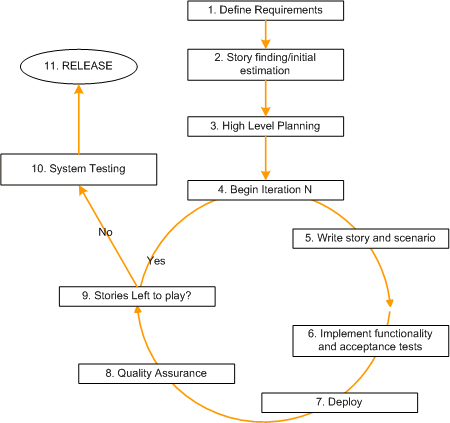
Figure 1 uses the terminology of the Scrum methodology.  The rest of this article uses the terminology popularized in the mid-1990s by the Unified Process (Sprint = Iteration, Backlog = Stack, Daily Scrum Meeting = Daily Meeting).  Figure 1 shows how agilists treat requirements like a prioritized stack, pulling just enough work off the stack for the current iteration (in Scrum iterations/sprints are often 30-days long, although this can vary).  At the end of the iteration the system is demoed to the stakeholders to verify that the work that the team promised to do at the beginning of the iteration was in fact accomplished.

The Scrum construction life cycle of Figure 1, although attractive proves to be a bit naive in practice. It's actually the result of initial requirements envisioning early in the project.  You don't only implement requirements during an iteration, you also fix defects (disciplined agile teams have a parallel testing effort during construction iterations where these defects are found), go on holiday, support other teams (perhaps as reviewers of their work), and so on.  So you really need to expand the product backlog into a full work items list.  You also release your system into production, often a complex endeavor.
A more realistic life cycle is captured Figure 2, over viewing the full agile SDLC.  This SDLC is comprised of six phases: Iteration -1, Iteration 0/Warm Up, Construction, Release/End Game, Production, and Retirement.  Although many agile developers may talk at the idea of phases, it's been recognized that processes such as Extreme Programming (XP) and Agile Unified Process (AUP) do in fact have phases.  The Disciplined Agile Delivery (DAD) lifecycle also includes phases (granted, I lead the development of DAD).
Figure 2
Figure 3
Figure 4

On the surface, the agile SDLC of Figure 4 looks very much like a traditional SDLC, but when you dive deeper you quickly discover that this isn't the case.  This is particularly true when you consider the detailed view of Figure 2.  Because the agile SDLC is highly collaborative, iterative, and incremental the roles which people take are much more robust than on traditional projects.  In the traditional world a business analyst created a requirements model that is handed off to an architect  who creates design  models that are handed off to a coder who writes programs which are handed off to a tester and so on.  On an agile project, developers work closely with their stakeholders to understand their needs, they pair together to implement and test their solution, and the solution is shown to the stakeholder for quick feedback.  Instead of specialists handing artifacts to one another, and thereby injecting defects at every step along the way, agile developers are generalizing specialists with full life cycle skills.

2. Iteration-1: Pre-Project Planning
Iteration -1, the “pre-Inception phase” in the Enterprise Unified Process (EUP), is the pre-project aspects of portfolio management.  During this phase you will:
  • Define the business opportunity:  You must consider the bigger business picture and focus on market concerns.  This includes exploring how the new functionality will improve your organization’s presence in the market, how it will impact profitability, and how it will impact the people within your organization.  This exploration effort should be brief, not all projects will make the initial cut so you only want to invest enough effort at this point to get a good “gut feel” for the business potential.  A good strategy is to follow Outside-In Development’s focus on identifying the potential stakeholders and their goals, key information to help identify the scope of the effort.
  • Identify a viable for the project: There are several issues to consider when identifying a potential strategy for the project.  For example, do you build a new system or buy an existing package and modify it?  If you decide to build, do you do so onshore or offshore?  Will the work be solely done by your own development team, by a team from a system integrator (SI), or in partnership with the SI?  What development paradigm – traditional/waterfall, iterative, or agile – will you follow?  Will the team be co-located, near-located within the same geographic region, or far-located around the world?   As you can see there are many combination of strategy available to you, and at this point in time you may only be able to narrow the range of the possibilities but be forced to leave the final decision to the project team in future iterations.
  • Assess the feasibility: During Iteration -1 you will want to do just enough feasibility analysis to determine if it makes sense to invest in the potential project.  Depending on the situation you may choose to invest very little effort in considering feasibility, for many systems just considering these issues for a few minutes is sufficient for now, and for some systems you may choose to invest days if not weeks exploring feasibility.  Many organizations choose to do just a little bit of feasibility analysis during Iteration -1, and then if they decide to fund the project they will invest more effort during Iteration 0.  In my experience you need to consider four issues when exploring feasibility: economic feasibility, technical feasibility, operational feasibility, and political feasibility.   Your feasibility analysis efforts should also produce a list of potential risks and criteria against which to make go/no-go decisions at key milestone points during your project.  Remember that agile teams only have a success rate of 72%, compared to 63% for traditional projects, implying that almost 30% of agile projects are considered failures.  Therefore you should question the feasibility of the project throughout the life cycle to reduce overall project risk.
Iteration -1 activities can and should be as agile as you can possibly make it – you should collaborate with stakeholders who are knowledgeable enough and motivated enough to consider this potential project and invest in just enough effort to decide whether to consider funding the effort further. 

3. Iteration 0/Warm up: Project Initiation
The first week or so of an agile project is often referred to as “Iteration 0” (or "Cycle 0") or in The Eclipse Way the "Warm Up" iteration.  Your goal during this period is to initiate the project by:
  • Garnering initial support and funding for the project: This may have been already achieved via your portfolio management efforts, but realistically at some point somebody is going to ask what are we going to get, how much is it going to cost, and how long is it going to take. You need to be able to provide reasonable, although potentially evolving, answers to these questions if you're going to get permission to work on the project.  You may need to justify your project via a feasibility study.
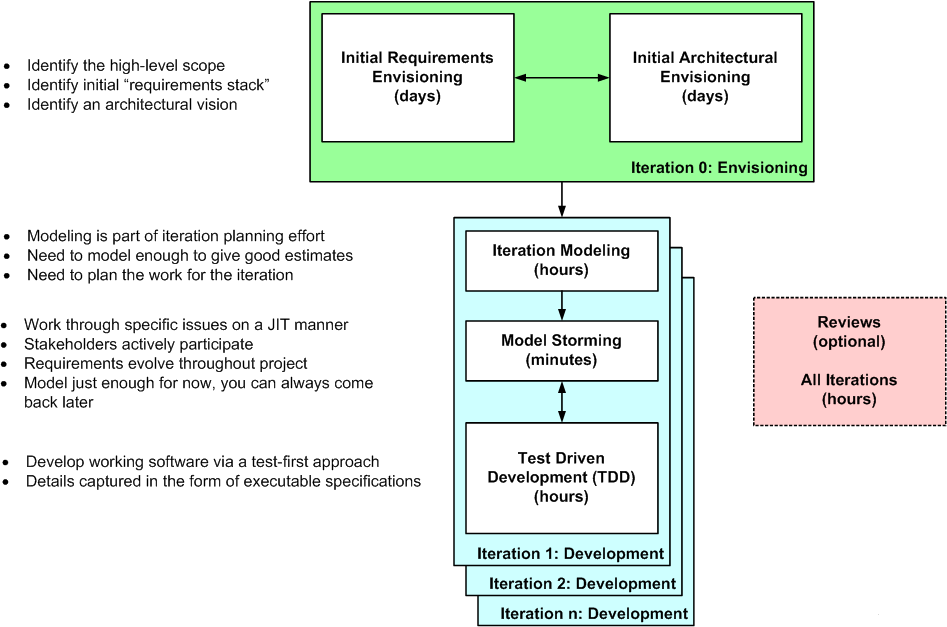
  • Actively working with stakeholders to initially model the scope of the system: As you see in Figure 5, during Iteration 0 agilists will do some initial requirements modeling with their stakeholders to identify the initial, albeit high-level, requirements for the system.  To promote active stakeholder participation you should use inclusive tools, such as index cards and white boards to do this modeling – our goal is to understand the problem and solution domain, not to create mounds of documentation.  The details of these requirements are modeled on a just in time (JIT) basis in model storming sessions during the development cycles.
  • Starting to build the team: Although your team will evolve over time, at the beginning of a development project you will need to start identifying key team members and start bringing them onto the team.  At this point you will want to have at least one or two senior developers, the project coach/manager, and one or more stakeholder representatives.
  • Modeling an initial architecture for the system: Early in the project you need to have at least a general idea of how you're going to build the system.  Is it a mainframe COBOL application?  A .Net application?  J2EE?  Something else?  As you see in Figure 5, the developers on the project will get together in a room, often around a whiteboard, discuss and then sketch out a potential architecture for the system.  This architecture will likely evolve over time, it will not be very detailed yet (it just needs to be good enough for now), and very little documentation (if any) needs to be written.  The goal is to identify an architectural strategy, not write mounds of documentation.  You will work through the design details later during development cycles in model storming sessions and via TDD.
  • Setting up the environment: You need workstations, development tools, a work area, .. for the team.  You don't need access to all of these resources right away, although at the start of the project you will need most of them.
  • Estimating the project: You'll need to put together an initial estimate for your agile project based on the initial requirements, the initial architecture, and the skills of your team.  This estimate will evolve throughout the project.
Figure 5
4. Construction Iteration:
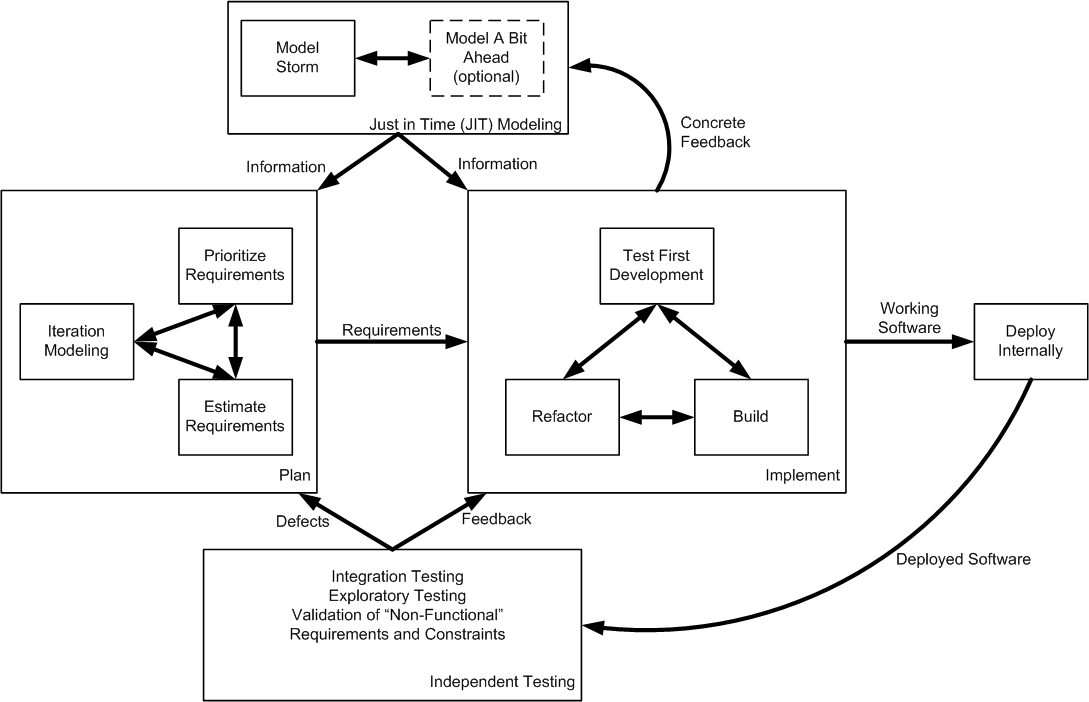
During construction iterations agilists incrementally deliver high-quality working software which meets the changing needs of our stakeholders, as over viewed in Figure 6.
Figure 6

We achieve this by:
  • Collaborating closely with both our stakeholders and with other developers: We do this to reduce risk through tightening the feedback cycle and by improving communication via closer collaboration.
  • Implementing functionality in priority order: We allow our stakeholders to change the requirements to meet their exact needs as they see fit.  The stakeholders are given complete control over the scope, budget, and schedule – they get what they want and spend as much as they want for as long as they’re willing to do so.
  • Analyzing and designing: We analyze individual requirements by model storming on a just-in-time (JIT) basis for a few minutes before spending several hours or days implementing the requirement.  Guided by our architecture models, often hand-sketched diagrams, we take a highly-collaborative, test-driven design (TDD) approach to development (see Figure 7) where we iteratively write a test and then write just enough production code to fulfill that test.  Sometimes, particularly for complex requirements or for design issues requiring significant forethought, we will model just a bit ahead to ensure that the developers don't need to wait for information.
  • Ensuring quality: Agilists are firm believers in following guidance such as coding conventions and modeling style guidelines.  Furthermore, we refactor our application code and/or our database schema as required to ensure that we have the best design possible.
  • Regularly delivering working software: At the end of each development cycle/iteration you should have a partial, working system to show people.  Better yet, you should be able to deploy this software into a pre-production testing/QA sandbox for system integration testing.  The sooner, and more often, you can do such testing the better.  See Agile Testing and Quality Strategies: Discipline Over Rhetoric for more thoughts.
  • Testing, testing, and yes, testing: As you can see in Figure 8 agilists do a significant amount of testing throughout construction.  As part of construction we do confirmatory testing, a combination of developer testing at the design level and agile acceptance testing at the requirements level.  In many ways confirmatory testing is the agile equivalent of "testing against the specification" because it confirms that the software which we've built to date works according to the intent of our stakeholders as we understand it today. This isn't the complete testing picture: Because we are producing working software on a regular basis, at least at the end of each iteration although ideally more often, we're in a position to deliver that working software to an independent test team for investigative testing.  Investigative testing is done by test professionals who are good at finding defects which the developers have missed.  These defects might pertain to usability or integration problems, sometimes they pertain to requirements which we missed or simply haven't implemented yet, and sometimes they pertain to things we simply didn't think to test for.
Figure 7: Taking "test first" approach to construction
Figure 8: Testing during Construction Iteration
5. Release Iteration(s): The "End Game"
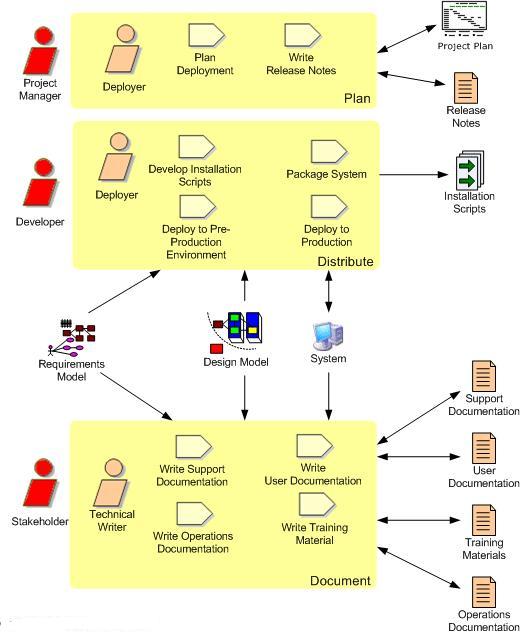
During the release iteration(s), also known as the "end game", we transition the system into production.  Not that for complex systems the end game may prove to be several iterations, although if you've done system and user testing during construction iterations (as indicated by Figure 6) this likely won't be the case.  As you can see in Figure 9, there are several important aspects to this effort:
  • Final testing of the system: Final system and acceptance testing should be performed at this point, although as I pointed out earlier the majority of testing should be done during construction iterations.  You may choose to pilot/beta test your system with a subset of the eventual end users.  Check Full Life Cycle Object-Oriented Testing (FLOOT) method for more thoughts on testing.
  • Rework: There is no value testing the system if you don't plan to act on the defects that you find.  You may not address all defects, but you should expect to fix some of them.
  • Finalization of any system and user documentation: Some documentation may have been written during construction iterations, but it typically isn't finalized until the system release itself has been finalized to avoid unnecessary rework  Note that documentation is treated like any other requirement: it should be costed, prioritized, and created only if stakeholders are willing to invest in it. Agilists believe that if stakeholders are smart enough to earn the money then they must also be smart enough to spend it appropriately.
  • Training.
  • Deploy the system
Figure 9: The AUP Deployment discipline Workflow
6. Production:
The goal of the Production Phase is to keep systems useful and productive after they have been deployed to the user community. This process will differ from organization to organization and perhaps even from system to system, but the fundamental goal remains the same: keep the system running and help users to use it. Shrink-wrapped software, for example, will not require operational support but will typically require a help desk to assist users. Organizations that implement systems for internal use will usually require an operational staff to run and monitor systems.

This phase ends when the release of a system has been slated for retirement or when support for that release has ended. The latter may occur immediately upon the release of a newer version, some time after the release of a newer version, or simply on a date that the business has decided to end support.  This phase typically has one iteration because it applies to the operational lifetime of a single release of your software. There may be multiple iterations, however, if you defined multiple levels of support that your software will have over time.

7. Retirement:
The goal of the Retirement Phase is the removal of a system release from production, and occasionally even the complete system itself, an activity also known as system decommissioning or system sun setting.  Retirement of systems is a serious issue faced by many organizations today as legacy systems are removed and replaced by new systems.  You must strive to complete this effort with minimal impact to business operations.  If you have tried this in the past, you know how complex it can be to execute successfully.  System releases are removed from production for several reasons, including:
  • The system is being complete replaced: It is not uncommon to see homegrown systems for human resource functions being replaced by COTS systems such as SAP or Oracle Financial s.
  • The release is no longer to be supported: Sometimes organizations will have several releases in production at the same time, and over time older releases are dropped.
  • The system no longer needed to support the current business model: A organization may explore a new business area by developing new systems only to discover that it is not cost effective.
  • The system is redundant: Organizations that grow by mergers and/or acquisitions often end up with redundant systems as they consolidate their operations.
  • The system has become obsolete.
In most cases, the retirement of older releases is a handled during the deployment of a newer version of the system and is a relatively simple exercise.  Typically, the deployment of the new release includes steps to remove the previous release.  There are times, however, when you do not retire a release simply because you deploy a newer version.  This may happen if you can not require users to migrate to the new release or if you must maintain an older system for backward compatibility.